


- What is Sound and What is Noise?
- Scale of Sound the Decibel(dB)
- Why Measure Sound?
- What is Frequency Weighting
- The human hearing range – what can you hear?
- Loudness and pitch for speech and communication
- Loudness and pitch for music
- Exposure to the noise level above 85 dB(A)
- Exposure to the noise level above 100 dB(A)
- When can noise damage our hearing?
- Why does hearing get worse with age?
- Noise and Your Health
- Protecting Your Hearing
You can avoid noise-induced hearing loss. Protect your hearing for life.
Compiled By

Ananda Pannila, CPhyst
Principle Acoustic Consultant
soundenv Pvt. Ltd.
Phone: +94 71 439 1931
[email protected]
www.soundenvca.com

Sound/Noise and Human Being
Sound is such a common part of everyday life. It permits us an enjoyable experience in listening to music or the singing of birds. It permits spoken communication with others. But in modern society, sound annoys us. Many sounds are unpleasant or unwanted; hence we call them Noise. However, how much noise annoys us depends not only, its quality but our attitude to it.
Imagine that you are studying in your room. Meanwhile, your neighbor’s dog keeps barking. This makes it difficult to concentrate on your notes. After a while, it starts getting on your nerves. You may think of the barking sound as noise. It’s really annoying, and not something you want to hear while you try to study for your big test!
Imagine that you are studying in the same room. Meanwhile, your own dog keeps barking. It is a general indication that someone is coming to your home. Then your own dog barking is considered as a warning signal. It is useful information for you. Then you don’t consider it as a noise.
From a scientific point of view, sound and noise are technically the same – they are vibrations in the air that we pick up with our ears. The bigger the waves are (their amplitude), the stronger the vibrations are, and the louder the sound is. However, the sound is something that we hear in general. Noise is something that we can hear but don’t necessarily want to hear.
What is Sound and What is Noise?
Sound is defined as any pressure variation in the air or other medium that the human ear can detect. If these variations in atmospheric pressure occur more rapidly, at least 20 times per second, they can be heard and hence are called sound. The number of pressure variations per second is called the “Frequency” of the sound, which is measured in cycles per second – Hertz(Hz).
Noise is defined as “unwanted sound,” which means that human beings, the recipients of sound, are the ultimate judges of what noisy sound is and what is not.
A sound is a form of energy that is transmitted by pressure variations that the human ear can detect. When one plays a musical instrument, say a guitar, the vibrating chords set air particles into vibration and generate pressure waves in the air. A person nearby may then hear the sound of the guitar when the pressure waves are perceived by the ear. Sound can also travel through other media as well.
Apart from musical instruments, sound can be produced by many other sources – a man’s vocal cord, a running engine, a vibrating loudspeaker diaphragm, an operating machine tool, and so on.
Noise is an unwanted sound. Usually, the sound of a violin is referred to like music – is something pleasing. Depending on other factors, the sound may be perceived as noise. Noise perception is subjective. Factors such as the magnitude, characteristics, duration, and time of occurrence may affect one’s subjective impression of the noise. When playing two loud music also considered as a Noise.
Figure 1 – Pressure Variation in Air

( Source: Brüel & Kjær)
Scale of Sound the Decibel(dB)
Sound waves involve a succession of compression and refraction of an elastic medium such as air. These waves are characterized by the amplitude of pressure changes, their frequency, and velocity of propagation. These quantities are interrelated as follows:
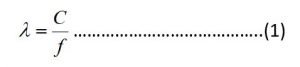
where C is the speed of sound, f is the frequency, λ is the wave length
The speed of sound in air at the temperature of 20 0C is approximately 344 m/s. Sound travels much faster in solids than in air. For example, the speed of sound is 3900 m/s in wood and 5000 m/s in steel.
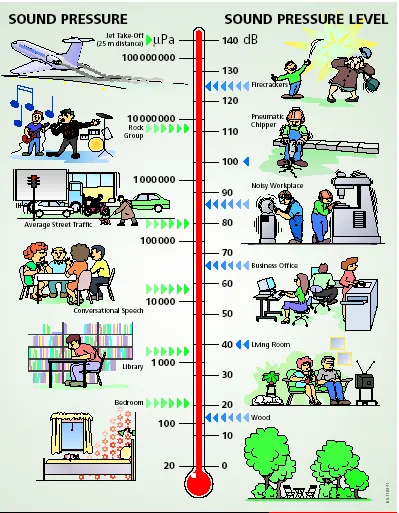
Frequency is defined as a number of compression and rarefactions per unit time (sec). The unit of frequency is Hertz(Hz). Normally hearing sensitivity of a healthy person is in the range of 20 to 20000 Hz. This range is called the audio frequency range. Sound pressure is used as the fundamental measure of sound, as it is measurable by directly by instrument. The weakest sound pressure disturbance that can be detected by an ‘average’ person at 1000 Hz is about 20 µN/m2. The largest sound pressure level which can be heard without discomfort is an odder of 10 8 µN/m2. Because of such a wide range, the use of a linear pressure scale has been found to be impractical. It has been found that it is convenient to measure the sound as a relative quantity with respect to a reference level. Thus, if we have to measure sound in a pressure unit, we would end up with quite large and unmanageable numbers. To avoid this, another scale has been defined – The Decibel (dB). By this definition, the sound pressure range of interest is compressed between 0 to 140 (dB), a range convenient use.
The sound pressure level (SPL) is given by the formula,

Where, P is the measured value in Pa( sound pressure in Pascal )and Pref is a standardized reference level of 20 μPa – the threshold of hearing (ISO 1996-1).
Figure 2 – Sound Pressure Levels of Different Sources (Source: Brüel & Kjær)
Why Measure Sound
There are many benefits of sound measurements. Sound measurements permit precise scientific analysis of annoying sound. However, we must remember that due to the physiological differences between individuals, the degree of sound annoyance cannot be measured for a person. In common practice, maximum permitted levels are defined for environmental purposes. In the case of the determination of source noise, we need a proper design noise measurement system. Sound measurement also clearly indicates when sound may cause hearing damage or annoyance to a person, and audiometric testing permits the evaluation of an individual’s hearing sensitivity. Finally, measurement and analysis of sound is a powerful diagnostic tool in noise reduction programs in factories, airports, highways, etc.
What is Frequency Weighting – Introduction to “dB(A)”
The ear is not equally sensitive to sound at all frequencies. In particular, its sensitivity falls at low frequencies and very high frequencies. It would seem relatively simple to build an electronic filter circuit which sensitivity varied with the frequency the same way as the human ear. Internationally standardized three frequency weighting networks are used in sound level meters, and they are termed the ‘A’ ,’ B’, and ‘C’ weighting networks. The ‘A’ network approximates the equal loudness curve at low SPL, the ‘B’ network at medium SPL, and ‘C’ network at high SPL. Since ‘A-weighted’ decibel provides a good estimate for human ears, it is commonly used in environmental noise measurements. The ‘A-weighted’ decibel is called dB(A).
|
Figure 3 – Equal Loudness Contours for Pure Tones (Source: Brüel & Kjær) |

The human hearing range – what can you hear? Loudness and pitch
Figure 4- Threshold of Sound (Source: Brüel & Kjær)

Loudness and pitch
The human hearing range is a description of the pitches and loudness levels a person can hear before feeling discomfort. There are a variety of sounds in our environment, ranging from faint sounds like birdsong and rustling leaves to louder sounds like music, yelling, and industrial noise. This human hearing range is called the audible range. The human hearing range depends on both the pitch of the sound – whether it is high or low – and the loudness of the sound. Pitch is measured in Hertz (Hz), and loudness is measured in sone. Unit of loudness is a subjective characteristic of a sound (as opposed to the sound-pressure level in decibels, which is objective and directly measurable).
For a person with normal hearing, when it comes to pitching the human hearing range starts low at about 20 Hz. That’s about the same as the lowest pedal on a pipe organ. On the other side of the human hearing range, the highest possible frequency heard without discomfort is 20,000Hz. While 20 to 20,000Hz forms the absolute borders of the healthy young human hearing range, our hearing is most sensitive in the 500 – 5000 Hz frequency range.
Loudness and pitch for speech and communication
A very useful range of pitch for speech and communication is 200 -5000 Hz, and loudness ranges from 30 -65 dB. This ability to speak is a key feature that sets man apart from other animals. Sensitivity is maximized within this auditory range as a gift from nature to us. Unfortunately, this frequency range is the first to be affected by prolonged exposure to high noise. It is essential to maintain our speech ability throughout our lives without exposure to loud noises that can lead to hearing impairment. Hearing loss can be caused by exposure to loud noise in the workplace and by listening to loud music during their leisure time.
Loudness and pitch for music
The ability to play music and enjoy listening to it is one of the key points that distinguish humans from animals. A very useful range of pitch for music is 50 -10,000 Hz, and loudness ranges from 30 -75 dB. Bass guitar and drums can produce low-frequency music up to 50 Hz, and violin and guitar can produce a high-frequency range up to 10,000 Hz. Women have the ability to sing in a higher frequency range than men. Unfortunately, most people do not have their hearing sensitivity in the frequency range from 50 -10,000 Hz. However, the music is the same; different people listen in different ways as per their hearing sensitivity. But people are not able to explain to others what they have heard. But when music is noisy, it can develop into a deafening hearing.
Exposure to noise level above 85 dB(A)
Sounds at 85 dB(A )can lead to hearing loss if you listen to them for more than 8 hours at a time and continue to expose them for a prolonged time. The sounds over 85 dB(A) can damage your hearing faster. Noise exposure is a kind of “Noise Dose “which measures with time. As per the recommendation given by the World Health Organisation, the maximum daily exposure level for 8 hour period is 85 dB(A). The safe listening time is cut in half for every 3-dB rise in noise levels over 85 dB(A). If the sound goes up to 88 dB(A), it is safe to listen to those same sounds for 4 hours. And if the sound goes up to 91 dBA, your safe listening time is down to 2 hours. When the sound level is 100 dB(A), the exposure level should be less than 15 minutes. The workers who work in the heavy machinery area of an industry can expose to the high noise level in the range of 85-100 dB(A). All workers in such areas should wear hearing protectors to prevent possible hearing damage.
Listen to music with headphones using a smartphone or MP3 player is very popular among children and teenage.
What is the decibel level can produce by the headphone or ear plugs inside the ear canal? As per our investigation decibel level can reach to 95-100 dB(A),when the volume control of the device is closer to the maximum level.This is very serious situation. WHO announce that the children and teenage are in higher risk of getting hearing impairment at their early stage of life due to lisure time noise exposure .
Exposure to noise level above 100 dB(A)
Exposures in noise levels over 100 dB(A) are extremely dangerous without an ear protector, even for a short period. It can lead to a temporary hearing loss. If you get such exposure accidentally, you must give complete rest to your ear in the following days. If you are exposed to such a high noise level regularly, chances of getting permanent hearing loss are very high. The noise level inside the many nightclubs and discotheques is higher than 100 dB(A). The Association of head and neck surgeons in America says “Noise level in nightclubs may increase risk of hearing loss “.
When can noise damage our hearing?
Our ears are constantly exposed to sounds, which can be damaging. Noise above 140 decibels, like a loud explosion, bomb blast, or fireworks, can lead to acute hearing loss. If the sound waves damage the eardrum, the middle ear, and/or the inner ear, it is known as acoustic trauma. This kind of damage is usually temporary, but some hearing loss may be permanent.
A single loud blast or explosion that lasts for less than 1 second can cause permanent hearing loss right away. This noise, called impulse noise or impact noise, may come from gunfire or fireworks. We measure impulse noise in dB peak pressure, or dB(P). Impulse noise greater than 140 dB(P) will hurt your hearing right away.
Why does hearing get worse with age?
It’s very common for people’s hearing to worsen as they get older. About 25 to 40 out of 100 people over the age of 65 are affected. Half of all people above the age of 75, and 80% of 80-year-olds, are hard of hearing. This usually affects their ability to understand what people are saying more than the range of tones they can hear, and they can hear low frequencies better than high frequencies. That’s why people with age-related hearing loss find it particularly difficult to follow conversations in noisy environments.
The exact causes of age-related hearing loss aren’t known. Changes in the inner ear and brain are thought to play a role.
Nowadays, there are various sound-amplifying hearing aids that improve people’s hearing and help them understand conversations. All of these hearing aids filter out background noise. They are adapted to the individual needs of their wearer and can be worn behind or in the ear, where they are hardly visible.
Noise and Your Health
Loud noise does not just hurt your hearing. It can cause other problems that you may not think of as being noise-related.
Noise can make you more tired and cranky. Loud noise can cause other health problems, like:
- high blood pressure
- faster heart rate
- upset stomach
- problems sleeping, even after the noise stops
- problems with how babies develop before birth
Noise can make it harder to pay attention. You may be less safe at work because you may not hear warning signals or equipment problems. Noise can also cause you to get less work done.
Protecting Your Hearing
Knowing how noise impacts you is the key to protecting your hearing. You’ve taken that first step by reading this information.
The next step is to avoid loud noise whenever possible. Remember, if you have to shout to be heard, it is too loud. You should get away from the noise or find a way to protect your ears.
Here are some things you can do:
- Wear hearing protection. Cotton in the ears will not work. You can buy things that protect your hearing, like earplugs or earmuffs, at the store or online.
- Do not listen to loud sounds for too long. Move away from the loud sound if you don’t have hearing protection. Give your ears a break after exposed to any loud noise. Plug your ears with your fingers as emergency when you expose to loud sound unexpectedly.
- Lower the volume. Keep personal listening devices set to no more than half volume. The World Health Organization recommends a total of 40 hours of weekly exposure to volume levels no higher than 80 dB for adults and 75 dB for children on personal listening devices. Don’t be afraid to ask others to turn down the volume of their devices if you can hear them too loud. Ask the movie theater manager to turn down the sound if the movie is too loud.
- Be a good consumer. Look for noise ratings on appliances, sporting equipment, power tools, and hair dryers. Buy quieter products. This is especially important when buying toys for children.
- Be a local advocate. Some movie theaters, health clubs, dance clubs, bars, and amusement centers are very noisy. Speak to managers about the loud noise and how it may hurt hearing. Ask that they turn the volume down.
Don’t be fooled by thinking your ears are “tough” or that you can “tune it out”! Noise-induced hearing loss is usually slow and painless. But, it is permanent. The hair cells and hearing nerve cannot be fixed. If loud sounds don’t bother you, you may already have some hearing damage.
You can avoid noise-induced hearing. Protect your hearing for life. Follow three thumb rules:
- Avoid Too Loud Noise.
- Avoid Too Long Exposure.
- Avoid Too Close Listening.
Sources Used for this article:
- Guideline for Community Nose –World Health Organisation (WHO)
- Hearing loss due to recreational exposure to loud sounds – World Health Organisation (WHO)
- Occupational Noise Hazard – IOSH
- Listening Safe Make Safe – World Health Organisation (WHO)
- The Human Hearing Range-What can you hear?-WIDEX
- Loud Noise Danger – ASHA
Compiled By
Ananda Pannila, CPhyst
Principle Acoustic Consultant
soundenv Pvt. Ltd.
Phone: +94 71 439 1931
[email protected]
www.soundenvca.com