
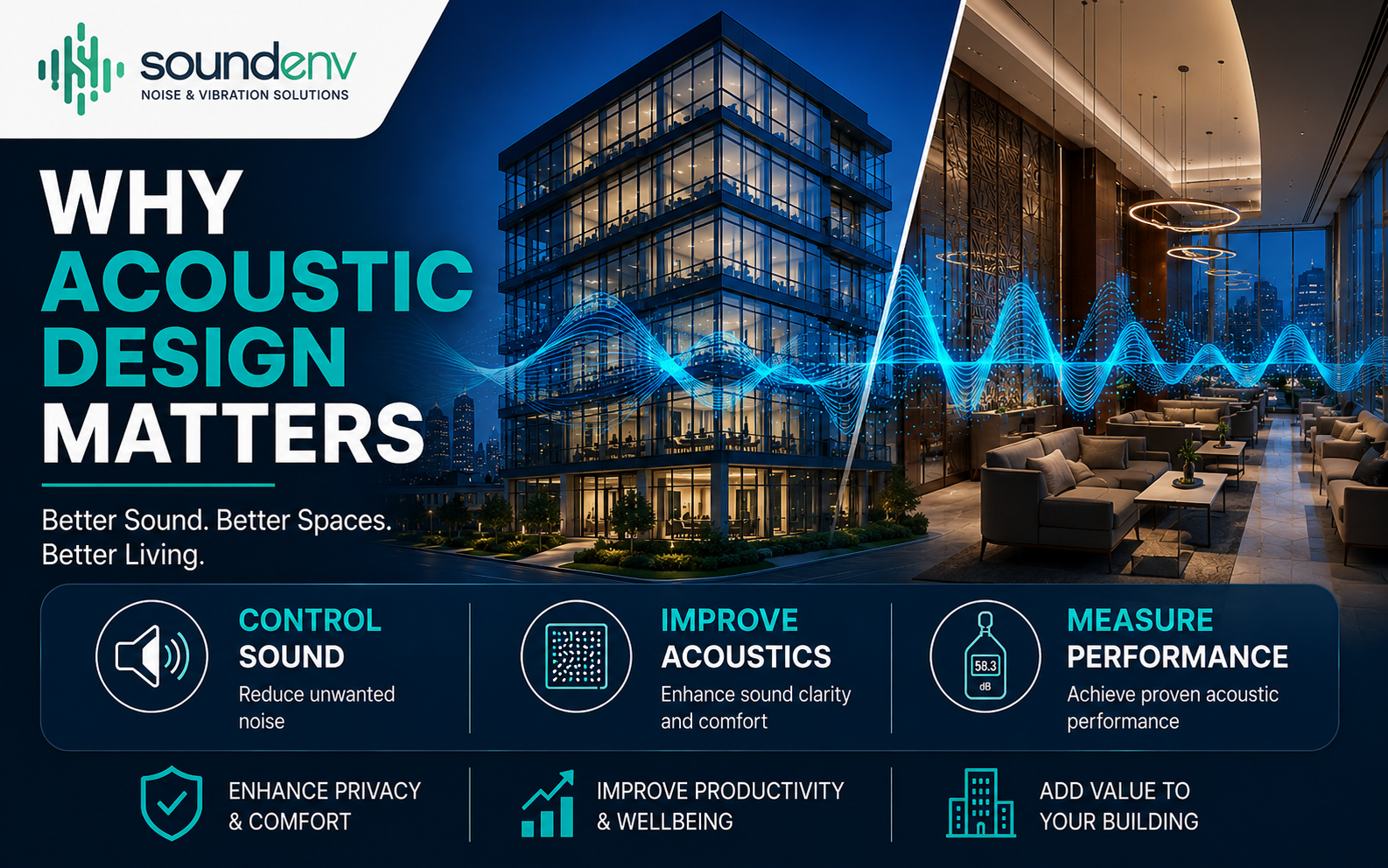
Modern buildings are no longer evaluated only by their external appearance or architectural beauty. Today, the true value of a building also depends on how effectively it performs for its intended purpose. One of the most important performance aspects of any building is the quality of its indoor acoustic environment. Whether it is a hotel, office, auditorium, hospital, educational institute, apartment complex, or commercial building, proper acoustic performance plays a major role in user comfort, privacy, productivity, and overall satisfaction.
Architectural acoustics, also known as room acoustics, is the science of controlling sound behavior inside buildings. It involves designing interior spaces in a manner that provides suitable sound quality, speech clarity, privacy, and noise control according to the intended use of the building. In modern construction practices around the world, acoustic considerations are increasingly becoming an essential part of the building design process.
Unfortunately, in many developing countries, including Sri Lanka, acoustic design is still often neglected during the early stages of building development. In many cases, attention to acoustics is given only after occupants start complaining about excessive noise, echo problems, poor speech clarity, or lack of sound privacy. By that stage, the building has already been completed and occupied, making corrective modifications extremely difficult and costly.
Historically, acoustic treatment was considered mainly as a corrective solution after the completion of a building. However, modern building practices have clearly demonstrated that incorporating acoustic concepts during the design stage is far more effective and economical than attempting modifications later. Once the structure, partition systems, ceilings, and interior finishes are completed, changing them to improve acoustic performance may require major reconstruction work, interruption to business activities, and significant financial investment.
For this reason, architects and engineers should consider acoustic performance as an integral part of the overall building design from the very beginning. Early acoustic consultation helps to avoid future operational issues and ensures that the building performs efficiently according to its intended application.
Importance of Building Façade and Window Acoustic Design
One of the most critical aspects of modern building acoustics is the design of the external façade and glazing systems. In urban environments, buildings are continuously exposed to environmental noise generated by road traffic, railway operations, aircraft movement, industrial activities, and outdoor entertainment events. Among these noise sources, low-frequency noise generated from heavy vehicles, bass music from outdoor musical events, and mechanical equipment is particularly difficult to control.
Low-frequency sound has a greater ability to penetrate conventional walls, windows, and building structures. Therefore, proper acoustic design of glazing façades and window systems is essential to maintain comfortable indoor acoustic conditions. Selection of appropriate laminated glass thicknesses, double-glazed systems, air gaps, and acoustic sealing methods can significantly improve the sound insulation performance of a building envelope.
If façade acoustic performance is neglected during the design stage, occupants may experience sleep disturbance, reduced concentration, poor speech communication, and general discomfort inside the building. Correcting these issues after construction is extremely difficult and expensive. Therefore, acoustic façade design has become an essential requirement in modern high-rise buildings, hotels, apartments, hospitals, and commercial developments
Modern Acoustic Design Using ÖDEON Simulation Software
At SoundEnv, we use the internationally recognized acoustic simulation software Odeon Room Acoustics Software for building acoustic analysis and design optimization.
ÖDEON is one of the world’s leading room acoustic simulation platforms used by acoustic consultants, researchers, universities, and design engineers worldwide. The software allows accurate three-dimensional modelling of interior spaces and predicts important acoustic parameters before the building is constructed.
Using ÖDEON, acoustic consultants can evaluate:
- Reverberation Time (RT)
- Speech Transmission Index (STI)
- Sound pressure distribution
- Musical clarity
- Early reflections
- Sound strength
- Echo problems
- Acoustic defects inside rooms
One of the greatest advantages of ÖDEON software is the ability to identify potential acoustic problems during the design stage itself. This allows architects and engineers to optimize room shapes, ceiling designs, material selections, and interior finishes before construction begins. Such predictive modelling helps to avoid expensive corrective modifications after project completion.
At SoundEnv, we provide professional acoustic consultancy services to support architects, engineers, and developers during the building design stage.
By integrating architectural acoustics at the early design stage, building owners can avoid costly future modifications, improve user satisfaction, and enhance the long-term functional value of their buildings. Proper acoustic design is no longer a luxury — it is an essential requirement of modern building development.
For further information or professional acoustic consultancy services, please contact:
Ananda Pannila
Principal Acoustic Consultant
SoundEnv Pvt. Ltd.
Former Additional Director General
Industrial Technology Institute (ITI), Sri Lanka
📧 [email protected]
📞 +94 71 439 1931